Can I Use a Pay Stub to File Taxes?

When tax season rolls around, many people wonder, "Can I use my pay stub to file taxes?" The short answer is no, you generally can't use a pay stub to directly file your income tax return with the IRS. Pay stubs are excellent records of your earnings and deductions throughout the year, but they aren't the official tax documents required by the government.
I hear this question all the time. It's a natural assumption, right? Your pay stub shows your gross pay, your federal tax withheld, your state tax, Social Security, Medicare – all the numbers you need for your tax forms. But the IRS has specific requirements, and your pay stub, while incredibly useful, doesn't quite meet them for direct submission.
The Truth About Pay Stubs and Tax Filing
Let's get straight to it. The Internal Revenue Service (IRS) requires specific official documents to verify your income and tax withholdings. For most employees, this document is Form W-2, Wage and Tax Statement. For independent contractors or freelancers, it's typically Form 1099-NEC, Nonemployee Compensation, or other 1099 forms.
Why this distinction? Your employer issues these official forms to both you and the IRS. They serve as a cross-reference. The IRS needs to know that the income you report matches what your employer reported paying you. A pay stub, while generated by your employer, is primarily an internal record for you. It's not sent to the IRS by your employer.
Think of it this way: your pay stub is like a receipt from your grocery store. It shows what you bought and paid. But if you're trying to return an item, the store needs a specific return form or proof of purchase, not just any old receipt. The W-2 is that official "return form" for your taxes.
OK, so what does this actually mean for you? It means waiting for your W-2 or 1099 before you actually submit your tax return. Employers must mail these forms by January 31st each year.
Pay Stub vs. W-2: What's the Real Difference?
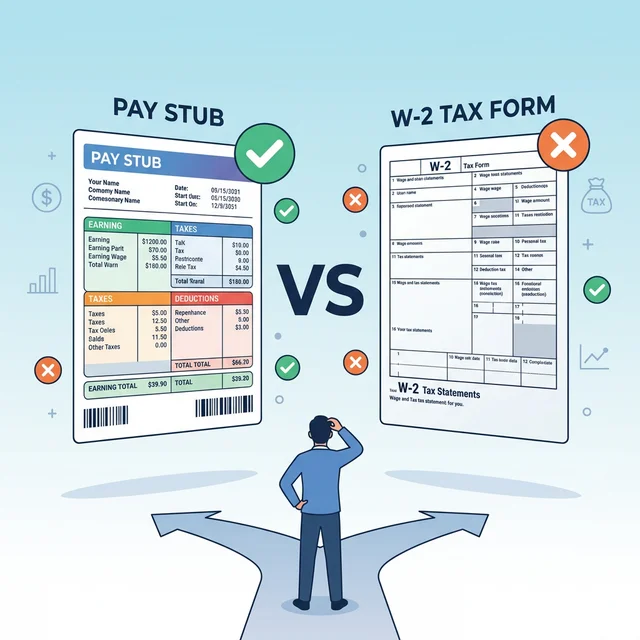
Many folks get these two documents confused. They look similar, with lots of numbers and deductions. But their purpose and official standing are quite different. Let's break it down in a quick comparison:
| Feature | Pay Stub | W-2, Wage and Tax Statement |
|---|---|---|
| Purpose | Personal record of earnings, deductions, and net pay per pay period. | Official annual statement of wages earned and taxes withheld for tax filing. |
| Frequency | Issued each pay period (weekly, bi-weekly, monthly). | Issued once annually, by January 31st. |
| Recipient(s) | Employee only. | Employee and the IRS (and relevant state/local tax agencies). |
| Legal Standing | Informational; proof of income for other purposes. | Official tax document required for filing federal and state income taxes. |
| Required by IRS | No. | Yes, for employees. |
You see the main distinction there. The W-2 is the one the IRS wants. It's designed to summarize your entire year's earnings and withholdings in a standardized format that tax software and IRS systems can easily process.
But wait, there's a catch. Even though you can't file with a pay stub, it's an incredibly valuable document. In my experience, clients who keep good records of their pay stubs are always better prepared for tax season. They can quickly spot discrepancies or verify information once their W-2 arrives.
When Pay Stubs Can Be Your Best Friend (Even If Not for Direct Filing)
While your pay stubs won't go directly into the IRS portal, they play a supporting role that's nothing short of critical. Don't toss them!
Verifying Your Information
When your W-2 finally arrives in late January, how do you know it's correct? You check it against your pay stubs. This is where those meticulous records pay off.
- Gross Wages: Add up the "Year-to-Date" (YTD) gross wages from your last pay stub of the year. This sum should match Box 1, Box 3, and Box 5 of your W-2. If it doesn't, you need to figure out why.
- Federal Income Tax Withholding: Check your YTD federal tax withheld against Box 2 of your W-2. Did your employer send the right amount to the government?
- State and Local Taxes: The same goes for state and local income taxes (Boxes 17-20 on the W-2).
- FICA Taxes: Social Security (Box 4) and Medicare (Box 6) are also usually easy to verify. For 2026, the Social Security tax rate for employees is 6.2% on earnings up to the annual limit, and the Medicare tax rate is 1.45% on all earnings, without a limit. If your YTD calculations match, you're in good shape.
- Pre-Tax Deductions: Contributions to a 401(k), health savings account (HSA), or flexible spending account (FSA) are often pre-tax deductions that reduce your taxable income. Your pay stubs will show these. Make sure they're accurately reflected, or excluded from, your W-2's taxable boxes (Box 1, for example).
Finding an error on your W-2 before you file saves you a headache later. If you find one, you'll need to contact your employer to request a corrected W-2 (Form W-2c). Having your pay stubs makes this conversation much easier.
If you ever need to generate a clear, detailed record of your income and deductions, perhaps because your employer's stubs are, let's say, less than clear, an online paystub maker can be a fantastic tool. You can input the necessary data to create professional-looking documents.
Proof of Income for Other Needs
Your pay stubs might not be for the IRS, but they're gold for many other purposes. Need to prove your income? They're usually the first document requested.
- Loan Applications: Whether it's for a mortgage, a car loan, or even a personal loan, lenders want to see your current income. They typically ask for your last two or three pay stubs.
- Renting an Apartment: Landlords often require recent pay stubs to verify you can afford the rent.
- Unemployment Benefits: When applying for unemployment, you'll need proof of your previous earnings. Pay stubs fit the bill perfectly.
- Social Security or Disability Benefits: These agencies will need to verify your work history and earnings.
In my experience, having easy access to your pay stubs for these moments is a lifesaver. It speeds up processes and prevents delays. If you're a small business owner, knowing how to create pay stubs for employees properly is essential for their financial needs too.
Tracking Your Financial Health
Beyond official requirements, pay stubs are a fantastic personal finance tool.
- Budgeting: They show you exactly where your money goes. Gross pay, net pay, and every deduction in between. This clarity helps you manage your spending.
- Understanding Deductions: Ever wonder why your take-home pay seems low? Your pay stub details all the deductions: taxes, health insurance premiums, retirement contributions, maybe even union dues.
- Spotting Errors: Not just tax errors, but also incorrect hours, wrong pay rates, or unauthorized deductions. I've seen clients catch all sorts of mistakes just by reviewing their stubs. (Nobody's perfect, after all!)
- Retirement Planning: Seeing your 401(k) contributions on each stub can be a powerful motivator for long-term savings.
If you ever find yourself needing a professional, accurate pay stub quickly for any of these reasons, you can create your pay stub in minutes using a reliable online service.
What to Do If You Don't Have Your W-2
So, January 31st has come and gone, and your W-2 is nowhere to be found. Don't panic. This happens more often than you'd think.
- Contact Your Employer: Your first step should always be to reach out to your employer's payroll or HR department. They might have an online portal where you can access it, or they can re-send it. Give them a reasonable amount of time to get it to you.
- Contact the IRS: If you still haven't received your W-2 by mid-February, or if your employer won't cooperate, you can contact the IRS directly. They'll generally wait until after February 14th to assist. You can call them or visit an IRS Taxpayer Assistance Center. They'll reach out to your employer on your behalf.
- Use Form 4852 (Substitute W-2): If April 15th (or the tax deadline) is approaching and you still don't have your W-2, you can file Form 4852, "Substitute for Form W-2, Wage and Tax Statement." This is where your pay stubs become critical. You'll use the information from your last pay stub for the year to estimate your wages and withholdings. It's not ideal, but it's a valid way to file on time if you're in a pinch. You can find more information about this process in IRS Publication 505, Tax Withholding and Estimated Tax.
Real talk: while Form 4852 is an option, it's always best to get the official W-2. Using the substitute form increases the chances of a discrepancy that could trigger an IRS inquiry.
The Case of Independent Contractors and 1099s
If you're an independent contractor, freelancer, or gig worker, your situation is a little different. You won't receive a W-2. Instead, if you're paid more than $600 by a single client in a calendar year, they should issue you a Form 1099-NEC (Nonemployee Compensation) by January 31st.
Independent contractors don't typically get pay stubs. This means diligent record-keeping is even more . You're responsible for tracking your own income and expenses throughout the year. While you won't use a pay stub to file taxes, you'll use your own financial records and your 1099s. We've covered the differences between official documents like these and less formal ones in our article on Validpaystubs Vs Realcheckstubs.
The federal minimum wage remains $7.25 per hour, but many states have higher rates. This impacts how payroll is calculated for employees, but contractors manage their own rates. For employers, understanding employee vs. contractor classification is vital for tax purposes. The U.S. Small Business Administration provides excellent guidance on how to pay independent contractors correctly.
Common Pay Stub Pitfalls and How to Avoid Them
Even with the best intentions, I've seen clients run into trouble with their pay stubs. Here are a few things to watch out for:
- Outdated Information: Sometimes, an old address or an incorrect marital status might linger on a pay stub. While it won't affect your tax filing directly, it could be a sign of deeper issues with your employer's records.
- Incomplete Data: Some employers use very basic pay stubs that don't clearly break down all deductions or year-to-date totals. This makes verification difficult. If your pay stubs are consistently unclear, it might be worth asking your employer for more detailed ones. Or, if you need to present clear income verification, you can always use a check stub maker to create a clean, document from your raw payroll data.
- Misunderstanding Deductions: Not all deductions reduce your taxable income. Health insurance premiums might be pre-tax, but a deduction for a company picnic probably isn't. Know the difference! The Fair Labor Standards Act (FLSA), overseen by the U.S. Department of Labor, dictates what can and can't be deducted from an employee's wages.
Are you meticulously checking every single item on your pay stub? You should be! It's your money, after all. A little vigilance can save you a lot of grief later on. Remember, even if a pay stub isn't "official" for the IRS, it's a vital part of your financial paper trail. Learning the difference between a fake vs real paystub is also a good skill to have, especially when dealing with income verification requests.
Your Actionable Takeaway
So, while you can't submit your pay stubs directly to the IRS for tax filing, they're indispensable tools for managing your finances, verifying your official tax documents, and providing proof of income for countless other life events. Keep every pay stub, review them carefully, and use them as your personal audit trail. They'll empower you to catch errors, plan your budget, and ensure your W-2 is spot-on come tax time. Make sure you get that W-2, but don't underestimate the power of your pay stub.
Frequently Asked Questions
Can I estimate my taxes using only my pay stubs?
Yes, you can estimate your taxes using your year-to-date figures on your last pay stub, especially if you're trying to project your tax liability or fill out a Form 4852. However, these are estimates only and should be confirmed with your official W-2 or 1099 forms before filing your actual tax return.
What if I lost my W-2? Can a pay stub replace it?
No, a pay stub can't officially replace a lost W-2 for direct submission to the IRS. If you've lost your W-2, first contact your employer to request a copy. If that fails, you can contact the IRS for assistance or, as a last resort, use Form 4852 with information from your pay stubs to file an estimated return.
Why do banks and landlords accept pay stubs if the IRS doesn't?
Banks and landlords accept pay stubs as proof of income because they need a recent snapshot of your current earning capacity, not your official annual tax filing document. A pay stub shows your current gross and net pay, which directly reflects your ability to make loan payments or rent, whereas a W-2 is a historical summary.
Do independent contractors get pay stubs?
Generally, no. Independent contractors typically don't receive pay stubs from their clients because they aren't employees. Instead, they receive Form 1099-NEC for nonemployee compensation from clients who pay them $600 or more in a year. Contractors are responsible for tracking their own income and expenses.
Sources
- Employer's Tax Guide (Publication 15) — Internal Revenue Service
- Tax Withholding and Estimated Tax (Publication 505) — Internal Revenue Service
- How to Pay Independent Contractors — U.S. Small Business Administration
- Fair Labor Standards Act (FLSA) — U.S. Department of Labor
- Social Security Fact Sheet — Social Security Administration (PDF)

About ValidPaystubs Editorial Team
Articles on ValidPaystubs are written and maintained by the editorial team at Sweethelp LLC, the company that operates this site from Sheridan, WY. We are a small team, not a firm of accountants — we build the tool and document how US payroll figures work, citing the IRS and state revenue departments so you can check any number against its source. Nothing here is tax, legal or financial advice, and for a decision that matters you should talk to a licensed professional.
View Profile