Pay Stub Requirements by State: Employer Obligations Guide (2026)

Pay Stub Requirements by State: Employer Obligations Guide (2026)
One of the most common questions we hear from employees is: "Is my employer legally required to give me a pay stub?"
The answer is surprisingly complex: It depends on where you work.
Unlike federal income tax, there is no single federal law that mandates employers to provide a pay stub. The Fair Labor Standards Act (FLSA) only requires employers to keep records of hours worked and wages paid — but the actual obligation to provide that information to the employee falls to individual state laws.
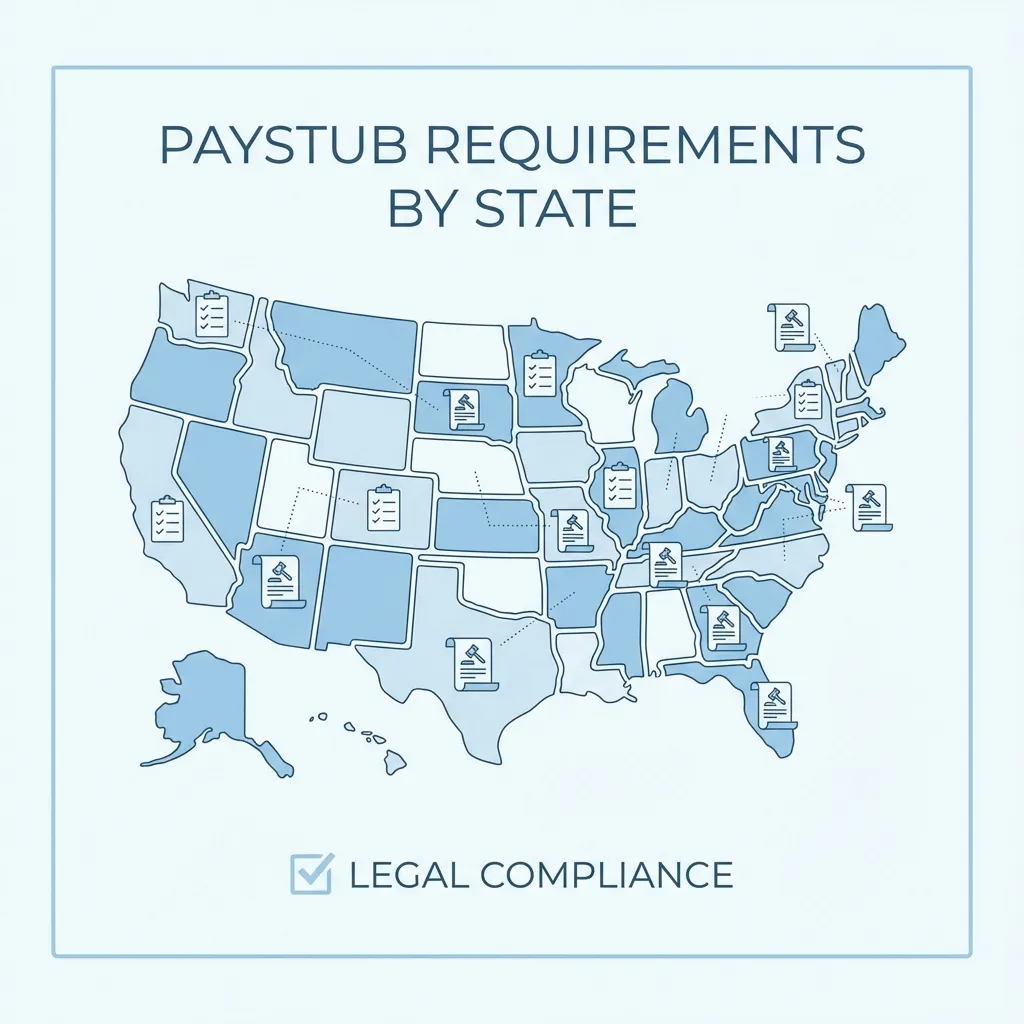
This creates a patchwork of regulations across all 50 states, ranging from extremely strict (California) to virtually nonexistent (Florida). In this guide, we'll break down exactly what your state requires, what information must be included, and what to do if your employer isn't complying.
The Three Categories of Pay Stub Laws
States generally fall into one of three categories regarding pay stub legislation. Understanding which category your state belongs to is essential for knowing your rights:
1. "Access/Print" States (Strict Requirement)
In these states, employers must provide a written or printable pay statement with every payment of wages. This is the strictest category and offers the most protection to employees. If an employer uses a digital payroll system, the employee must have the ability to easily access and print the document.
2. "Access" States (Digital Acceptable)
These states require employers to provide "access" to a pay statement, but it doesn't necessarily have to be a physical paper copy. Electronic access through an online portal satisfies the law, provided the employee can view all required details.
3. "No Requirement" States (No Statute)
Some states have no statutes requiring employers to provide a pay stub at all. In these states, an employer could theoretically hand you a check with zero explanation of deductions, and it would be legal (though bad business practice).
Note: Even in "No Requirement" states, most reputable employers still provide pay stubs to maintain trust, reduce payroll disputes, and protect themselves in case of audits.
Complete State-by-State Reference Table
Here is a comprehensive breakdown of pay stub requirements for all 50 states and Washington D.C. as of 2026:
| State | Category | Key Details |
|---|---|---|
| Alabama | Access | No specific pay stub statute; employers must maintain records |
| Alaska | Access/Print | Written statement required with each payment |
| Arizona | Access | Employers must keep records; no specific delivery mandate |
| Arkansas | No Requirement | No state statute requiring pay stubs |
| California | Access/Print | Strictest — Detailed itemized statement required (Labor Code §226) |
| Colorado | Access/Print | Written pay statement required with each payment |
| Connecticut | Access/Print | Itemized wage statement required every pay period |
| Delaware | Access/Print | Statement required showing gross/net and deductions |
| Florida | No Requirement | No state statute — but county ordinances may apply |
| Georgia | No Requirement | No pay stub statute; FLSA recordkeeping only |
| Hawaii | Access/Print | Written statement required; opt-in required for paperless |
| Idaho | Access | Employers must maintain accessible records |
| Illinois | Access/Print | Written or electronic statement required each pay period |
| Indiana | Access/Print | Detailed earnings statement required |
| Iowa | Access/Print | Written statement with deductions required |
| Kansas | Access | Records must be available to employees on request |
| Kentucky | Access | Employers must provide access to earnings records |
| Louisiana | No Requirement | No state statute requiring pay stubs |
| Maine | Access/Print | Employers must provide a written statement of wages |
| Maryland | Access/Print | Statement required showing earnings and deductions |
| Massachusetts | Access/Print | Detailed pay stub required each pay period |
| Michigan | Access/Print | Written statement of gross/net pay and deductions |
| Minnesota | Access/Print | Detailed earnings statement required (§181.032) |
| Mississippi | No Requirement | No state statute requiring pay stubs |
| Missouri | Access | Employers must keep records accessible to employees |
| Montana | Access/Print | Written statement of earnings required |
| Nebraska | Access/Print | Employers must provide a written wage statement |
| Nevada | Access/Print | Employers must provide a written record of wages |
| New Hampshire | Access/Print | Employers must furnish a statement of deductions each pay period |
| New Jersey | Access/Print | Statement of deductions required with each payment |
| New Mexico | Access/Print | Written statement of wages and deductions required |
| New York | Access/Print | Detailed statement required (Labor Law §195) |
| North Carolina | Access/Print | Written statement required for each pay period |
| North Dakota | Access/Print | Written statement of earnings required |
| Ohio | Access | Employers must maintain records; no specific delivery mandate |
| Oklahoma | Access | Records must be available; no specific statement required |
| Oregon | Access/Print | Itemized pay statement required each pay period |
| Pennsylvania | Access/Print | Statement of wages and deductions required |
| Rhode Island | Access/Print | Employers must provide statement of wages paid |
| South Carolina | Access | Employers must maintain accessible records |
| South Dakota | No Requirement | No state statute requiring pay stubs |
| Tennessee | No Requirement | No state statute requiring pay stubs |
| Texas | Access/Print | Written earnings statement required with each payment |
| Utah | Access/Print | Written statement of deductions required |
| Vermont | Access/Print | Statement of gross/net wages and deductions |
| Virginia | Access/Print | Written statement required each pay period |
| Washington | Access/Print | Detailed statement with gross/net and deductions (RCW 49.48.010) |
| West Virginia | Access/Print | Written statement of wages required |
| Wisconsin | Access/Print | Statement of deductions required each pay period |
| Wyoming | Access | Employers must maintain records; no specific delivery mandate |
| Washington D.C. | Access/Print | Itemized statement required with each payment |
Deep Dive: Key State Requirements
Let's look closer at some of the most populous states with specific and notable requirements.
California — The Strictest in the Nation
California has the most detailed pay stub laws in the country under Labor Code Section 226. Every employer must provide an itemized written statement that includes:
- Gross wages earned
- Total hours worked (for non-exempt employees)
- The number of piece-rate units earned (if applicable)
- All deductions (itemized, not lumped together)
- Net wages earned
- Inclusive dates of the pay period
- Name of the employee and last 4 digits of SSN (or full employee ID)
- Full legal name and address of the employer entity
- All applicable hourly rates with hours worked at each rate
- Overtime rates and overtime hours worked
Penalties for non-compliance:
- First violation: $50 per employee per pay period
- Subsequent violations: $100 per employee per pay period
- Maximum aggregate penalty: $4,000 per employee
- Employees can also recover attorney's fees and costs
New York — Detailed and Strictly Enforced
New York requires pay stubs to be provided with every payment of wages under Labor Law §195. The statement must list:
- Dates of work covered by the payment
- Name of employee and employer
- Address and phone number of employer
- Rate or rates of pay and basis thereof (hourly, salary, piece-rate, etc.)
- Gross wages
- Itemized deductions (each deduction listed separately)
- Allowances claimed as part of minimum wage (like tip credits or meal credits)
- Net wages
- Regular and overtime hours worked (for non-exempt)
Penalty: Up to $5,000 per employee for willful violations, plus potential liquidated damages.
Texas — Access/Print with Federal Alignment
Texas falls into the "Access/Print" category. Employers must provide a written earnings statement with each payment. While Texas doesn't specify every required field as strictly as California, the standard deductions and earnings must be clear. Texas employers must also comply with Chapter 62 of the Texas Labor Code.
Florida — No State Requirement
Florida has no state-level pay stub law. However, employers in certain counties (like Miami-Dade) may be subject to local ordinances. Additionally, federal FLSA recordkeeping requirements still obligate employers to maintain accurate records available for Department of Labor inspection.
What Information Should Be on Every Pay Stub?
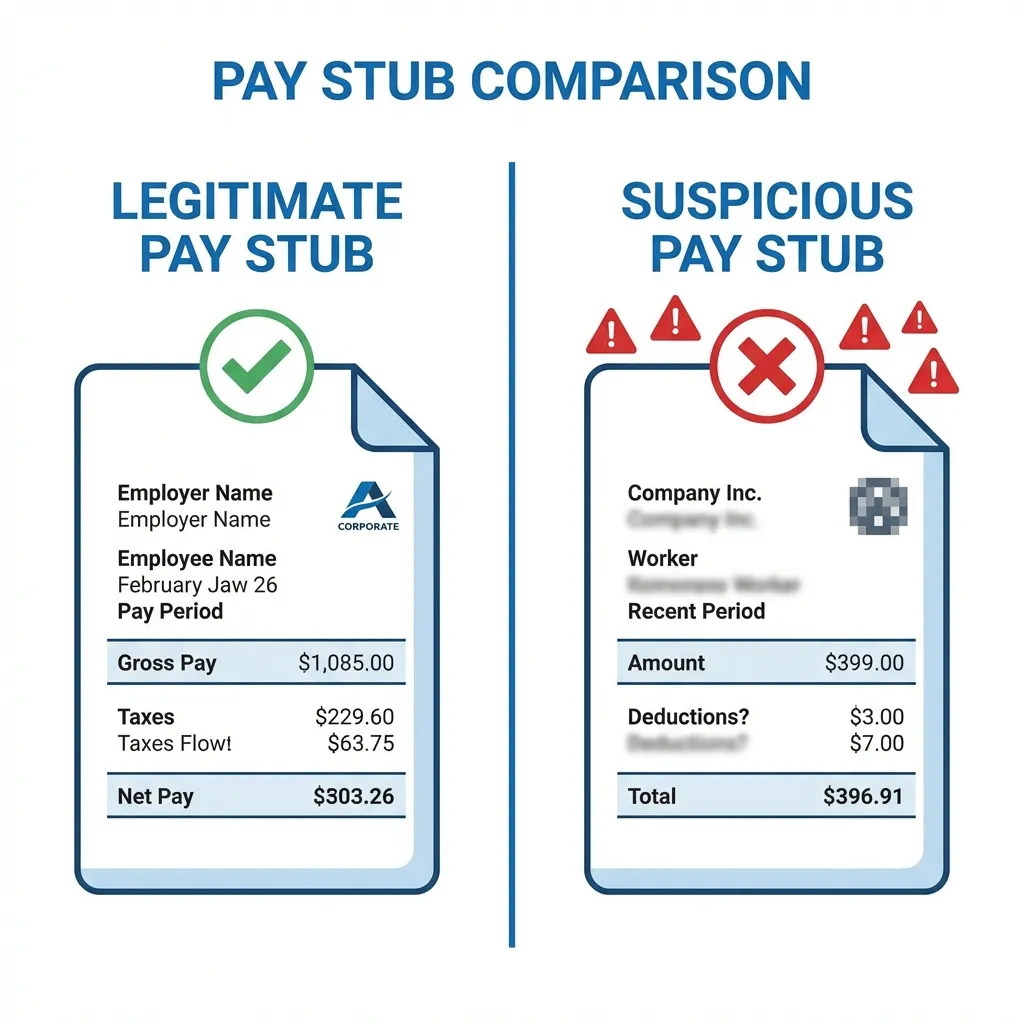
Even if your state has minimal requirements, best practice (and what lenders, landlords, and courts expect) dictates that a compliant pay stub should include:
Required by Most States
- Employee full name and identification number
- Employer name and address
- Pay period start and end dates
- Payment date
- Gross pay (total earnings before deductions)
- Net pay (actual amount deposited or paid)
- Itemized deductions including:
- Federal income tax
- State income tax (if applicable)
- Social Security (OASDI) — 6.2%
- Medicare — 1.45%
- Local taxes (if applicable)
- Year-to-date (YTD) totals for earnings and deductions
Best Practice Additions
- Hours worked (regular and overtime) for hourly employees
- Overtime rate and hours
- Vacation/PTO balance
- Employer contributions (401k match, health insurance)
- Check number or direct deposit reference
Using ValidPaystubs: Our paystub generator automatically includes all required fields based on your selected state, ensuring compliance with even the strictest state laws like California's Labor Code §226.
Electronic Pay Stubs: The Digital Rules
As the world goes digital, "Paperless Pay" has become the norm. But the rules around electronic delivery vary:
The "Opt-Out" vs "Opt-In" Distinction
- Opt-Out States: Employers can default to electronic pay stubs unless an employee specifically requests (opts out) to receive paper copies. This is the more common approach.
- Opt-In States: In stricter states (like Hawaii and Colorado), employers cannot switch to digital-only without the employee's prior written consent (opting in to paperless).
Key Electronic Pay Stub Requirements
Regardless of the method, these rules generally apply across states:
- Accessibility: Employees must be able to access their pay stubs without charge
- Printability: Employees must have the ability to print or download a copy
- Computer Access: If an employee doesn't have access to a computer at work, the employer may need to provide a paper copy
- Retention: Electronic records must be maintained for the same period as paper records (typically 3-7 years depending on state)
What To Do If Your Employer Refuses to Provide Pay Stubs
If you live in a state that requires pay stubs (Access or Print) and your employer refuses to provide one:
Step 1: Request in Writing
Send an email to HR or your manager requesting your earnings statement. Create a paper trail with the date, your request, and any response (or lack thereof).
Step 2: Cite the Specific Law
Reference your state's labor code directly. For example:
- California: "Per California Labor Code Section 226, I am entitled to an itemized statement of earnings with each payment."
- New York: "Per New York Labor Law §195, I am requesting the required pay statement for the period of [dates]."
Step 3: File a Complaint
If they still refuse, file a complaint with your state's Department of Labor. Most states have online complaint forms and will investigate on your behalf.
Step 4: Consult an Employment Attorney
For repeated or willful violations, you may be entitled to penalties, back pay, and attorney's fees — especially in states like California where statutory damages are significant.
If You Live in a "No Requirement" State
If the law isn't on your side, you still have practical options:
- Negotiate politely: Explain that you need pay stubs for a mortgage, apartment, or car loan application. Most employers will accommodate this request.
- Request bank statements: Your bank records provide an income trail that supplements missing pay stubs.
- Generate your own records: If you are a contractor or have the raw data (hours worked, rate of pay), you can use a paystub generator to create professional records for your own files. Always ensure the numbers match exactly what you were actually paid.
Frequently Asked Questions
Does my employer have to give me a pay stub?
In approximately 38 states plus D.C., yes — employers are required to provide either a written or electronically accessible pay statement. In 6 states (Arkansas, Florida, Georgia, Louisiana, Mississippi, South Dakota, Tennessee), there is no specific state statute requiring it.
How long must employers keep pay stub records?
The FLSA requires employers to retain payroll records for at least 3 years. Many states extend this to 4-7 years. California requires 3 years minimum.
Can I get pay stubs from a previous employer?
Yes. In Access/Print states, former employers are generally required to provide copies of your pay stubs upon request. Even in other states, most employers maintain these records and will provide them. See our guide on getting pay stubs from a previous employer.
What if my pay stub has errors?
Report errors to your HR or payroll department immediately in writing. If they refuse to correct documented errors, contact your state's labor board. Systematic errors may indicate broader payroll issues that affect other employees.
Are independent contractors entitled to pay stubs?
No. Independent contractors (1099 workers) are not employees and are not covered by pay stub laws. However, you can create your own professional income documentation using a paystub generator for applications and personal records.
Do pay stub requirements differ for small businesses?
Generally, no. Pay stub laws apply to all employers regardless of size in most states. However, some states exempt certain categories of employees (such as domestic workers or agricultural workers) from specific requirements.
Conclusion
Knowing your rights is half the battle. While federal law is silent on the obligation to provide pay stubs (only requiring employers to maintain records), your state likely offers significant protections to ensure you know exactly where your hard-earned money is going.
Whether you are an employer looking to stay compliant across multiple states, or an employee needing proof of income, ensuring accurate, accessible, and legally compliant pay stubs is a cornerstone of fair employment practices.
Need a state-compliant pay stub immediately? Generate a state-compliant pay stub now →
Sources & References
- U.S. Department of Labor — Fair Labor Standards Act (FLSA)
- DOL — Wage and Hour Division State Laws
- DOL — Recordkeeping Requirements Under FLSA
- California Labor Code Section 226 — Itemized Wage Statements
- New York Labor Law Article 6, §195
- Washington State RCW 49.48.010
- Minnesota Statute §181.032
- IRS Publication 15 — Employer's Tax Guide
- Social Security Administration — Contribution and Benefit Base

About ValidPaystubs Editorial Team
Articles on ValidPaystubs are written and maintained by the editorial team at Sweethelp LLC, the company that operates this site from Sheridan, WY. We are a small team, not a firm of accountants — we build the tool and document how US payroll figures work, citing the IRS and state revenue departments so you can check any number against its source. Nothing here is tax, legal or financial advice, and for a decision that matters you should talk to a licensed professional.
View Profile