How Much Tax is Taken Out of a Paycheck? 2026 Complete Calculator Guide
How Much Tax is Taken Out of a Paycheck? 2026 Complete Guide
You earned $1,000 this week. But when you check your bank account, only $750 landed. Where did the other $250 go?
Understanding paycheck taxes is one of the most practical personal finance skills you can have. Yet most people have only a vague sense of "the government takes a lot."
This comprehensive 2026 guide breaks down exactly what taxes are deducted from your paycheck, how they're calculated, and how to estimate your take-home pay before you even start a new job.
Quick Answer: How Much Will Be Taken?
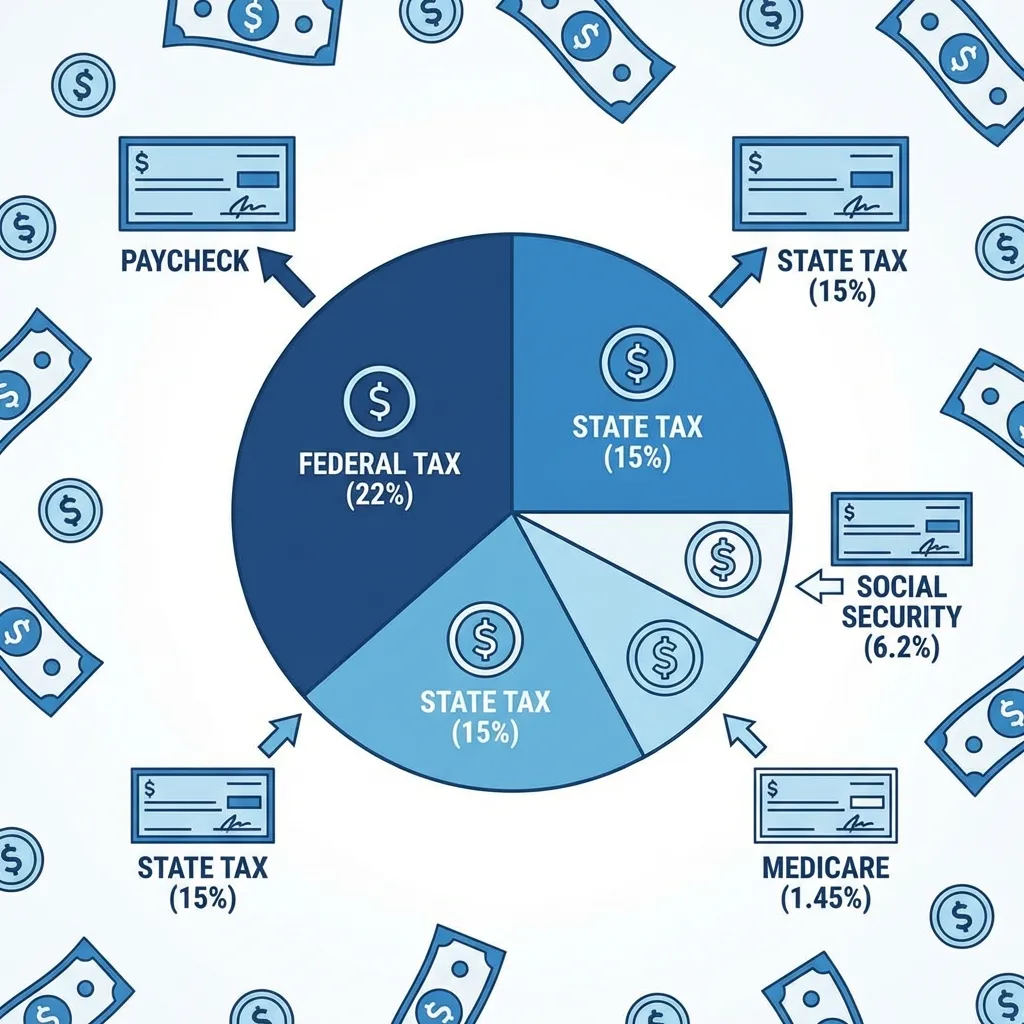
For most Americans, total paycheck deductions range from 20% to 35% of gross pay:
| Income Level | Typical Total Deduction |
|---|---|
| $30,000/year | 20-25% |
| $50,000/year | 23-28% |
| $75,000/year | 25-30% |
| $100,000/year | 27-32% |
| $150,000/year | 30-35% |
Actual percentages depend on state, filing status, and benefit elections.
The 5 Types of Paycheck Taxes
1. Federal Income Tax (FIT/FWT)
What It Is: Tax paid to the federal government on your earned income.
2026 Federal Tax Brackets (Single Filers):
| If Taxable Income Is | Tax Rate |
|---|---|
| $0 - $11,925 | 10% |
| $11,925 - $48,475 | 12% |
| $48,475 - $103,350 | 22% |
| $103,350 - $197,300 | 24% |
| $197,300 - $250,525 | 32% |
| $250,525 - $626,350 | 35% |
| Over $626,350 | 37% |
Important: These are marginal rates. You don't pay 22% on everything—you pay 10% on the first $11,925, 12% on the next portion, and so on.
What Affects Your Withholding:
- W-4 filing status (Single, Married Filing Jointly, Head of Household)
- Number of dependents claimed
- Additional withholding requested
- Pre-tax deductions (401k, HSA)
2. Social Security Tax (OASDI)
What It Is: Tax funding Social Security retirement and disability benefits.
2026 Rate: 6.2% (employee) + 6.2% (employer) = 12.4% total
2026 Wage Base: $168,600
What This Means: You pay 6.2% on every dollar earned up to $168,600. After that, no more Social Security tax for the year.
Example:
- $50,000 salary: $3,100/year in SS tax ($50,000 × 6.2%)
- $200,000 salary: $10,453.20/year in SS tax ($168,600 × 6.2%)
3. Medicare Tax (HI)
What It Is: Tax funding Medicare health coverage.
2026 Rate: 1.45% (employee) + 1.45% (employer) = 2.9% total
No Wage Cap: Unlike Social Security, Medicare applies to all earnings.
Additional Medicare Tax: If you earn over $200,000 (single) or $250,000 (married filing jointly), you pay an extra 0.9% on wages above that threshold.
4. State Income Tax
What It Is: Tax paid to your state government (if your state has income tax).
States With NO Income Tax:
- Alaska
- Florida
- Nevada
- New Hampshire (interest/dividends only)
- South Dakota
- Tennessee
- Texas
- Washington
- Wyoming
States With FLAT Income Tax:
- Colorado: 4.4%
- Illinois: 4.95%
- Indiana: 3.05%
- Kentucky: 4.0%
- Michigan: 4.25%
- North Carolina: 4.5%
- Pennsylvania: 3.07%
- Utah: 4.55%
States With High Progressive Rates:
- California: Up to 13.3%
- New York: Up to 10.9%
- Hawaii: Up to 11%
- New Jersey: Up to 10.75%
5. Local Income Taxes
What It Is: Additional taxes imposed by cities, counties, or school districts.
Major Cities With Local Tax:
- New York City: 3.078% - 3.876%
- Philadelphia: 3.75% (residents)
- Detroit: 2.4%
- Baltimore: 3.2%
- Cleveland: 2.5%
- Cincinnati: 1.8%
Who Pays: Usually residents of the jurisdiction, sometimes also those who work there.
Putting It All Together: Example Calculations
Example 1: $50,000/Year in Texas (No State Tax)
Gross per paycheck (bi-weekly): $1,923.08
| Deduction | Amount | Calculation |
|---|---|---|
| Federal Income Tax | $158.00 | Based on W-4, 12% bracket |
| Social Security | $119.23 | $1,923.08 × 6.2% |
| Medicare | $27.88 | $1,923.08 × 1.45% |
| State Tax | $0.00 | Texas has no state tax |
| Total Deductions | $305.11 | |
| Net Pay | $1,617.97 |
Effective Tax Rate: 15.9%
Example 2: $75,000/Year in California
Gross per paycheck (bi-weekly): $2,884.62
| Deduction | Amount | Calculation |
|---|---|---|
| Federal Income Tax | $295.00 | Based on W-4, 22% bracket |
| Social Security | $178.85 | $2,884.62 × 6.2% |
| Medicare | $41.83 | $2,884.62 × 1.45% |
| CA State Tax | $138.00 | CA progressive rates |
| CA SDI | $31.73 | $2,884.62 × 1.1% |
| Total Deductions | $685.41 | |
| Net Pay | $2,199.21 |
Effective Tax Rate: 23.8%
Example 3: $100,000/Year in New York City
Gross per paycheck (bi-weekly): $3,846.15
| Deduction | Amount | Calculation |
|---|---|---|
| Federal Income Tax | $485.00 | Based on W-4, 24% bracket |
| Social Security | $238.46 | $3,846.15 × 6.2% |
| Medicare | $55.77 | $3,846.15 × 1.45% |
| NY State Tax | $200.00 | NY progressive rates |
| NYC Tax | $118.46 | ~3.078% city tax |
| Total Deductions | $1,097.69 | |
| Net Pay | $2,748.46 |
Effective Tax Rate: 28.5%
How to Calculate Your Own Take-Home Pay
Step 1: Start with Gross Pay
Annual salary ÷ number of pay periods = gross per paycheck
Pay Period Frequency:
- Weekly: 52 pay periods
- Bi-weekly: 26 pay periods
- Semi-monthly: 24 pay periods
- Monthly: 12 pay periods
Step 2: Calculate FICA Taxes
Social Security: Gross × 6.2% (until you hit wage base)
Medicare: Gross × 1.45%
Combined FICA: Gross × 7.65%
Step 3: Estimate Federal Income Tax
Use IRS tax brackets and your W-4 information:
- Determine annual taxable income (gross minus pre-tax deductions)
- Apply progressive tax rates
- Divide by number of pay periods
Shortcut estimates:
- $40,000-$60,000/year: ~12% effective federal rate
- $60,000-$100,000/year: ~15-18% effective federal rate
- $100,000-$200,000/year: ~18-22% effective federal rate
Step 4: Add State Income Tax
Look up your state's rate:
- Flat tax states: Simple multiplication
- Progressive tax states: Similar to federal calculation
Step 5: Add Local Taxes (if applicable)
Check if your city/county has income tax and add that percentage.
Step 6: Subtract All from Gross
Gross - (Federal + FICA + State + Local) = Net Pay
Factors That Reduce Your Taxes
Pre-Tax Deductions
These reduce your taxable income:
401(k) Contributions: Every dollar you contribute reduces your taxable wages dollar-for-dollar.
Example: $75,000 salary with $5,000 401(k) = $70,000 taxable wages
HSA Contributions: Health Savings Account contributions are pre-tax.
FSA Contributions: Flexible Spending Account contributions reduce taxable income.
Health Insurance Premiums: If employer-sponsored, usually pre-tax.
Tax Credits and Deductions on W-4
The new W-4 (2020 and later) allows you to:
- Claim dependents (reducing withholding)
- Claim other credits
- Request additional withholding (increasing withholding)
Filing Status
Married Filing Jointly generally results in lower withholding than Single, because the brackets are wider.
Why Your First Paycheck Might Be Different
Common First-Paycheck Surprises
Higher than expected:
- Medical insurance hasn't kicked in yet
- 401(k) deductions not started
- Shorter pay period (started mid-period)
Lower than expected:
- Medical insurance started immediately
- Union dues began
- Didn't understand benefit costs
Adjust Your Expectations
When starting a new job, expect your first 2-3 paychecks to be somewhat unpredictable as:
- Benefits enrollment processes
- Deductions stabilize
- Any corrections are made
Tax Withholding vs. Actual Tax Owed
Important Distinction
Withholding: The amount your employer takes from each paycheck
Tax Owed: The amount you actually owe for the year (calculated when you file your return)
These numbers rarely match exactly.
Refund or Balance Due?
If withholding > tax owed: You get a refund
If withholding < tax owed: You owe the difference
The Goal
Ideally, withholding ≈ tax owed. A large refund means you've been giving the government an interest-free loan.
How to Adjust
If you consistently get large refunds or owe large amounts:
- Submit a new W-4 to your employer
- Use the IRS Tax Withholding Estimator (IRS.gov/W4app)
- Adjust your withholding for better accuracy
Special Situations
Multiple Jobs
If you work two or more jobs simultaneously:
- Each employer withholds independently
- You may end up underwithholding
- Use W-4's multiple jobs worksheet
- Consider requesting additional withholding
Self-Employment (1099 Income)
Self-employed individuals:
- Pay SE tax (15.3%) instead of employee FICA
- Make quarterly estimated payments
- No automatic withholding (unless requested)
Bonus and Commission
Supplemental wages are often withheld at flat 22% federal rate:
- May result in over-withholding
- Will true up at tax filing
High Earners ($200k+)
Watch for:
- Additional Medicare Tax (0.9%)
- Social Security wage base cap
- Higher marginal rates
- Potential AMT implications
2026 Specific Numbers to Know
Federal
- Standard Deduction (Single): $14,600
- Standard Deduction (MFJ): $29,200
- Social Security Wage Base: $168,600
- 401(k) Contribution Limit: $23,000 ($30,500 if 50+)
- HSA Limit (Individual): $4,150
- HSA Limit (Family): $8,300
FICA Rates
- Social Security: 6.2%
- Medicare: 1.45%
- Additional Medicare: 0.9% (above thresholds)
- Total FICA: 7.65%
Using This Information
For Job Negotiations
When evaluating a job offer, calculate net pay in your specific state to compare "actual" compensation.
Example: $80,000 in Texas vs. $85,000 in California might result in similar or even higher take-home in Texas due to no state income tax.
For Budgeting
Budget based on net pay, not gross. The money that matters is what hits your account.
For Retirement Planning
Understanding tax deductions helps you appreciate the value of pre-tax contributions. A $500/month 401(k) contribution might only cost $350-400 in net pay due to tax savings.
Frequently Asked Questions
Why do I owe taxes if I had money withheld all year?
Withholding is an estimate. If you have multiple income sources, investment income, or significant life changes, the estimate may be off.
Can I ask my employer to withhold more?
Yes. Use W-4 line 4(c) to request additional withholding per paycheck.
Why does my coworker with the same salary have different withholding?
Different W-4 elections: filing status, dependents, additional withholding, pre-tax deductions.
Are FICA taxes refundable?
No. Social Security and Medicare taxes are not refundable (with very rare exceptions for over-withholding from multiple jobs).
How do I know if I'm withholding correctly?
Use the IRS Tax Withholding Estimator (irs.gov/W4app) to check mid-year.
Summary
Your paycheck deductions include:
- Federal Income Tax: 10-37% (progressive)
- Social Security: 6.2% (up to wage base)
- Medicare: 1.45% (all income)
- State Income Tax: 0-13.3% (depends on state)
- Local Tax: 0-3.8% (depends on locality)
Total typical range: 20-35% of gross pay
Understanding these deductions helps you:
- Evaluate job offers accurately
- Budget realistically
- Optimize tax withholding
- Appreciate pre-tax benefits
Need professional pay stubs with accurate tax calculations?
2026 tax tables. All 50 states. Federal, state, and local calculations.
Sources & References

About ValidPaystubs Editorial Team
Articles on ValidPaystubs are written and maintained by the editorial team at Sweethelp LLC, the company that operates this site from Sheridan, WY. We are a small team, not a firm of accountants — we build the tool and document how US payroll figures work, citing the IRS and state revenue departments so you can check any number against its source. Nothing here is tax, legal or financial advice, and for a decision that matters you should talk to a licensed professional.
View Profile