Paystub vs. W2: Can You Really Use a Pay Stub Instead of a W2?
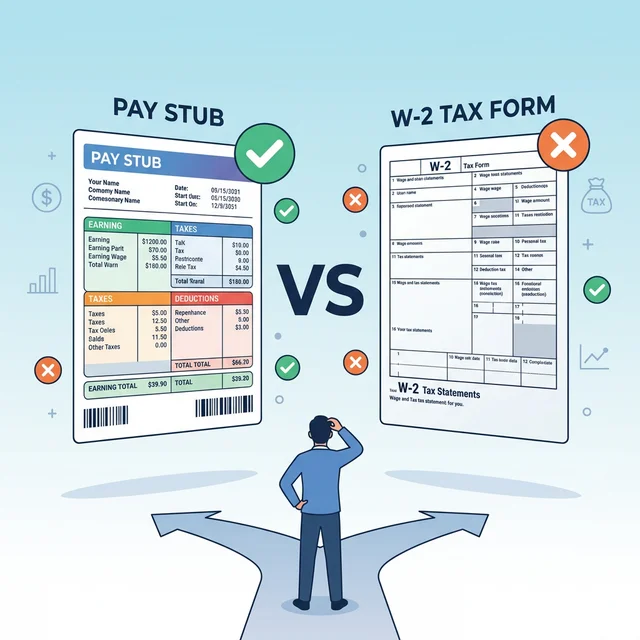
Generally, no, you can't use a paystub instead of a W2 for most official purposes like filing taxes. While a pay stub shows your earnings and deductions for a specific pay period, the W2 is the official year-end statement from your employer, summarizing all income and withheld taxes for the entire calendar year. It's an IRS-mandated form.
As someone who's spent eight years building payroll systems, I've seen firsthand the confusion surrounding pay stubs and W2s. People often think they're interchangeable because both documents display income and tax withholding information. They don't. While your pay stub is a snapshot of one pay cycle, your W2 is the grand summary. It's the definitive word on your annual earnings and tax situation, the one Uncle Sam cares most about.
Understanding the W2: Your Official Annual Tax Statement
The Form W-2, Wage and Tax Statement, is more than just a piece of paper. It's a critical document. Every employer has to send you one by January 31st each year. This form reports your annual wages and the amount of federal, state, and local taxes withheld from your pay during the previous calendar year.
Why is it so important? This form is what you attach to your federal income tax return. It's how the IRS, and your state tax authority, know exactly how much you earned and how much you've already paid in taxes. Without it, filing your taxes becomes incredibly difficult, if not impossible, without requesting substitute forms directly from the IRS or your employer. It’s also what the Social Security Administration uses to track your earnings for future benefits. According to the IRS Publication 15, Employer's Tax Guide, accurate W2 reporting is non-negotiable for employers.
Unpacking the Paystub: A Detailed Snapshot
A pay stub, or check stub, provides a detailed breakdown of your earnings and deductions for a single pay period. You get one every time you're paid. It shows your gross pay, which is your total earnings before any deductions. Then it lists out everything taken out: federal income tax, state income tax, Social Security tax, Medicare tax, health insurance premiums, 401(k) contributions, and maybe even a garnishment or two. Finally, it shows your net pay — the money you actually take home. Many pay stubs also include year-to-date (YTD) totals for these categories.
Think of it this way: your pay stub is like a single chapter in a book. The W2 is the entire book's summary, all wrapped up. While pay stubs are a fantastic way to track your current earnings and ensure your deductions are correct (something I always advise clients to do!), they lack the annual certification and consolidated data that a W2 provides. If you need a professional pay stub right now, you can create one in under 2 minutes.
Key Differences: W2 vs. Paystub
Let's break down the core distinctions between these two vital payroll documents. Knowing these differences helps you understand why one can't usually stand in for the other.
| Feature | W2 Form (Wage and Tax Statement) | Paystub (Check Stub) |
|---|---|---|
| Purpose | Official annual summary of wages and taxes for tax filing. | Detailed record of earnings and deductions for one pay period. |
| Issuing Body | Employer, as mandated by the IRS. | Employer, typically with each paycheck. |
| Frequency | Annually, by January 31st for the previous calendar year. | Weekly, bi-weekly, semi-monthly, or monthly. |
| Reporting Period | Entire calendar year (January 1st to December 31st). | Single pay period (e.g., two weeks). |
| Primary Use | Filing federal and state income taxes, Social Security earnings. | Personal record, budgeting, verifying current pay. |
| Legal Standing | Official IRS document, legally required for tax purposes. | Not an official IRS tax document. |
| Year-to-Date (YTD) | Contains full year's YTD totals. | Contains YTD totals up to that specific pay period. |
When Can You Use a Paystub? (Limited Scenarios)
There are definitely times when a paystub is exactly what you need. It's not completely useless for official stuff, just not for taxes. Here's when it usually works:
- Proof of Income for Loans or Leases: Lenders often ask for your most recent pay stubs. They want to see consistent income. Mortgage companies, car dealerships, and landlords use them to assess your ability to make payments. They might ask for the last two or three months of stubs to get a broader picture.
- Employment Verification: If you're applying for a new job, some employers might ask for recent pay stubs as part of their background check. This confirms your current or most recent salary and employment status.
- Applying for Government Benefits: Programs like unemployment or certain social services might request pay stubs to verify your current income levels and eligibility. They need current data.
- Personal Financial Planning: Regularly checking your pay stubs helps you budget effectively. You can see how much you're actually taking home and where your money goes. I tell everyone to keep an eye on their deductions, especially if they make changes to their 401(k) or health benefits.
- Dispute Resolution with Employer: If you believe there's a discrepancy in your pay or deductions, your pay stubs are your primary evidence. They document every single transaction.
Remember, even in these scenarios, the request often specifies "recent pay stubs" – meaning current, not necessarily for the full year. If you're managing your finances or trying to secure a loan, having accurate, professional pay stubs ready is a smart move. You can always make your check stub today if you need a quick document.
When You Absolutely Need a W2 (The Big Ones)
There are specific, non-negotiable situations where only a W2 will do. No exceptions, really.
- Filing Your Annual Income Taxes: This is the most obvious one. Your federal income tax return, state income tax return, and sometimes local returns all rely on the information from your W2. It details your gross wages, Social Security wages, Medicare wages, and all taxes withheld. Without it, the IRS doesn't have the official figures.
- Applying for a Mortgage (Sometimes): While recent pay stubs are often requested, some mortgage lenders, especially for larger loans, might insist on the previous year's W2s. They want to see a consistent, long-term employment history and income verification that only the W2 can provide.
- Social Security Benefits: Your W2 information is transmitted to the Social Security Administration (SSA). This data determines your future Social Security benefits. Every dollar reported on your W2 contributes to your earnings record with the SSA. For more on how the SSA uses this data, check out their benefits information.
- Financial Aid Applications: If you're applying for college financial aid, like FAFSA, you'll need tax information, which means W2 data. They often look at prior-prior year tax data, meaning you'll need W2s from a couple of years back.
Quick sidebar: Did you know the federal minimum wage is $7.25 per hour? That's what employers have to pay at least, according to the Fair Labor Standards Act (FLSA). Your W2 will reflect those earnings, whether minimum wage or more. It all gets reported.
Why Employers Provide Both
Employers send out both documents because they serve different, functions. The pay stub is a transparency tool, showing employees how their current pay was calculated. The W2 is a tax compliance tool, reporting annual earnings and withholdings to the government.
In my experience, good payroll practices involve clarity with both. Employers have a legal responsibility to provide accurate pay stubs and W2s. They're also responsible for withholding the correct amounts for taxes like FICA, which combines Social Security and Medicare taxes. For 2026, the employee's share of FICA is typically 7.65% (6.2% for Social Security up to the annual limit, and 1.45% for Medicare with no wage limit). You'll see these withholdings on both your pay stub and your W2.
For more on employer responsibilities and specific state laws regarding pay, our article on Last Paycheck Laws By State might be useful reading, as it touches on the importance of accurate wage statements.
Common Questions and Pitfalls
"What if my W2 is wrong?" That's a valid concern. If you notice discrepancies between your final pay stub's year-to-date totals and your W2, you must contact your employer immediately. They'll need to issue a corrected W2 (Form W-2c). Don't just file with the incorrect W2; that'll cause headaches with the IRS later.
Ever wonder why you get two different documents? It's really about timing and purpose. One is for your current check, the other for your yearly tax obligation. It might seem like overkill, but it's pretty important for keeping things straight, both for you and the government. (Sometimes I think the tax code is designed to confuse people, even for us payroll nerds!)
Another common pitfall: misplacing your W2. It happens. Don't panic.
What to Do if You Don't Have a W2
If January 31st has passed and you haven't received your W2, here's the game plan:
- Contact Your Employer: Start here. Ask for a copy. Many payroll departments can provide it quickly, sometimes electronically. This is often the fastest solution.
- Contact the IRS: If your employer can't or won't provide it, or you can't reach them, the IRS can help. You can call them directly or use Form 4852, "Substitute for Form W-2, Wage and Tax Statement," to estimate your wages and withholding. You'll use your final pay stub for the year to fill this out.
- Use Your Pay Stubs for Estimates: While you can't file with them, your final pay stub of the year provides all the Year-to-Date totals you need. If you absolutely can't get a W2 in time, you can use these figures to complete Form 4852. Just remember, this is a substitute, not the real thing.
For further reading on all things payroll and tax, you can always check out our payroll blog for more insights. Understanding terms like "gross pay," "net pay," and "deductions" is key, and our payroll glossary can help clarify any unfamiliar language.
Frequently Asked Questions
Can I use my last paystub for tax filing if I don't have my W2?
No, you can't directly use your last pay stub to file your federal or state income taxes. The W2 is the official document the IRS requires. However, if you can't obtain your W2, you can use the year-to-date totals from your final pay stub to help you fill out IRS Form 4852, which is a substitute for Form W-2.
What information does a W2 provide that a paystub doesn't?
A W2 provides certified annual totals for all wages and withheld taxes that are directly reported to the IRS and Social Security Administration. While a pay stub shows year-to-date totals, these aren't officially reported to the government in the same way. The W2 also includes specific codes for various types of compensation and benefits that are for tax calculations.
Is an employer legally required to provide paystubs?
It depends on the state. The Bureau of Labor Statistics (BLS) tracks state wage laws, and many states do mandate that employers provide pay stubs with each paycheck. Federal law, under the FLSA, doesn't specifically require them, but it does require accurate record-keeping of hours and wages, which pay stubs help .
How long should I keep my pay stubs and W2 forms?
It's generally recommended to keep your W2 forms for at least three years from the date you filed your tax return, or two years from the date you paid the tax, whichever is later. Some financial experts even suggest keeping them for seven years. For pay stubs, it's wise to keep them for at least a year, until you've reconciled them with your W2 and confirmed accuracy.
Practical Actionable Takeaway
Always prioritize obtaining your official W2 form from your employer for tax filing. If you need proof of income for a loan or lease, your recent pay stubs are typically sufficient, but be prepared for lenders to request W2s as well. Make it a habit to review every pay stub you receive, confirming your gross pay, deductions, and net income are correct. If you ever need a reliable, professional pay stub quickly for verification, check out our professional templates to generate one that meets your needs.
Sources
- Employer's Tax Guide (Publication 15) — Internal Revenue Service
- Fair Labor Standards Act — U.S. Department of Labor
- Retirement Benefits — Social Security Administration
- Wage Statistics — Bureau of Labor Statistics

About ValidPaystubs Editorial Team
Articles on ValidPaystubs are written and maintained by the editorial team at Sweethelp LLC, the company that operates this site from Sheridan, WY. We are a small team, not a firm of accountants — we build the tool and document how US payroll figures work, citing the IRS and state revenue departments so you can check any number against its source. Nothing here is tax, legal or financial advice, and for a decision that matters you should talk to a licensed professional.
View Profile