How to Create Paystub for Mortgage Application: Lender Requirements 2026
How to Create Paystub for Mortgage Application: Lender Requirements 2026
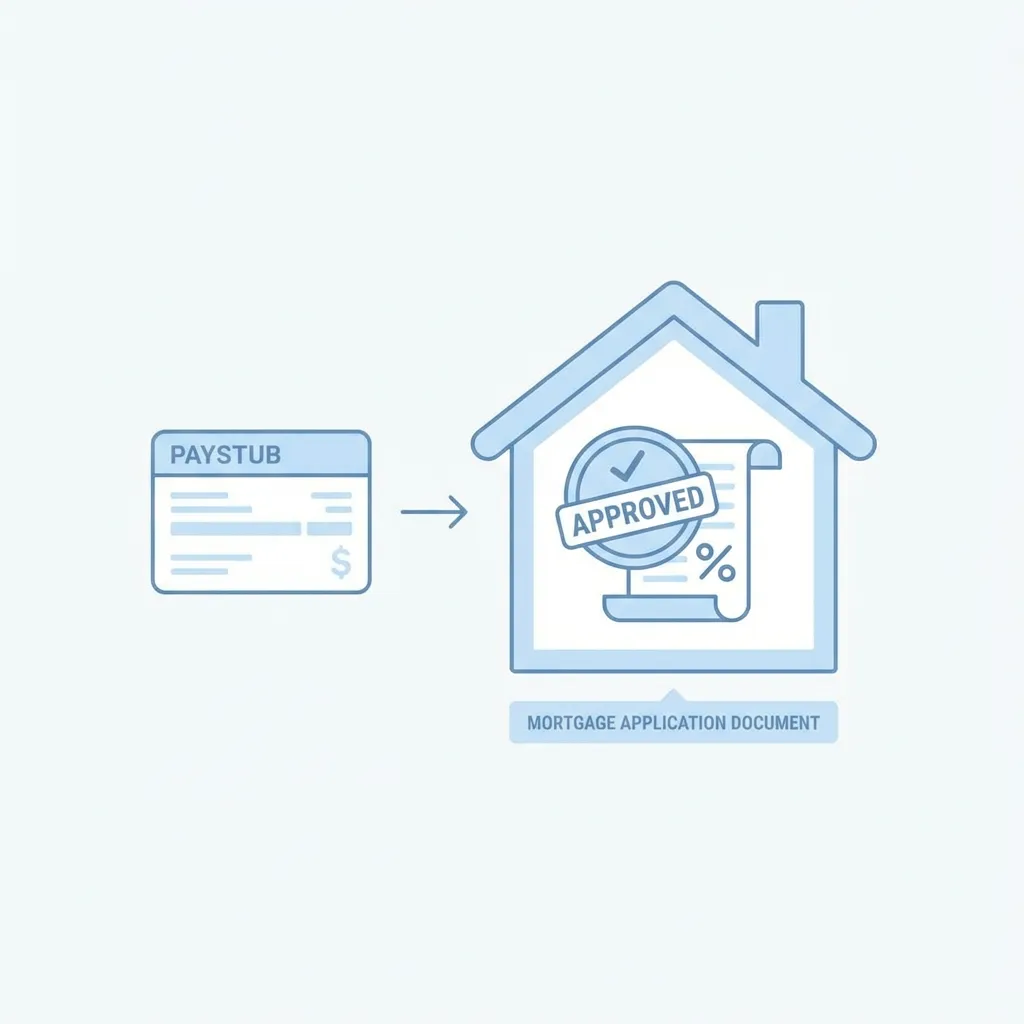
Applying for a mortgage? Lenders require paystubs for mortgage applications to verify income, calculate debt-to-income ratios, and assess your ability to repay the loan. This comprehensive guide shows you exactly what mortgage lenders need and how to create professional paystubs that meet their requirements.
Why Mortgage Lenders Require Paystubs
Mortgage lenders are among the strictest when it comes to income verification. They need to verify:
- Income Level - Can you afford the monthly mortgage payment?
- Income Stability - Is your income consistent and reliable?
- Employment Status - Are you currently employed?
- Debt-to-Income Ratio - How much debt can you handle?
Standard Mortgage Requirements:
- Gross monthly income must support the mortgage payment
- Debt-to-income ratio typically under 43% (some programs allow up to 50%)
- Proof of current, stable employment
- 2-3 months of recent paystubs minimum
What Mortgage Lenders Look For in Paystubs
1. Gross Monthly Income
Lenders calculate your maximum mortgage payment based on:
Maximum Monthly Payment = (Gross Monthly Income × DTI Ratio) - Other Monthly Debts
Example:
- Gross Income: $6,000/month
- DTI Ratio: 43%
- Other Debts: $500/month
- Maximum Mortgage Payment: $2,080/month
2. Income Consistency
Mortgage lenders prefer:
- ✅ Consistent income across all paystubs
- ✅ Steady employment (2+ years ideal, 6+ months minimum)
- ✅ Regular pay periods (weekly, bi-weekly, monthly)
- ✅ YTD totals that make sense
Red Flags:
- ❌ Wildly fluctuating income
- ❌ Recent job changes (< 6 months)
- ❌ Irregular pay periods
- ❌ YTD totals that don't add up
3. Employment Duration
How long you've been at your job matters:
| Employment Duration | Lender Perception | Documentation Needed |
|---|---|---|
| 2+ years | Low risk | Paystubs sufficient |
| 1-2 years | Moderate risk | Paystubs + employment letter |
| 6-12 months | Higher risk | Paystubs + offer letter + previous employment |
| < 6 months | High risk | May need co-signer or wait |
4. Year-to-Date (YTD) Totals
Lenders verify YTD totals match:
- Your tax returns (if available)
- Your stated annual income
- Your employment verification
Important: YTD totals must be accurate and cumulative across all paystubs.
How Many Paystubs Do You Need for a Mortgage?
Standard Requirement: 2-3 months of recent paystubs
Typical Scenarios:
| Pay Frequency | Number of Paystubs | Time Period |
|---|---|---|
| Weekly | 8-12 paystubs | 2-3 months |
| Bi-weekly | 4-6 paystubs | 2-3 months |
| Monthly | 2-3 paystubs | 2-3 months |
Most Common: 3 recent paystubs (last 6-8 weeks for bi-weekly pay)
Additional Documentation Often Required:
- Last 2 years of tax returns
- W-2 forms
- Employment verification letter
- Bank statements (2-3 months)
- Asset statements
Step-by-Step: Creating Paystubs for Mortgage Application
Step 1: Calculate Your Debt-to-Income Ratio
Before creating paystubs, verify you meet DTI requirements:
DTI Ratio = (Total Monthly Debts ÷ Gross Monthly Income) × 100
Example:
- Gross Monthly Income: $6,000
- Monthly Debts: $2,000 (car loan, credit cards, etc.)
- DTI Ratio: ($2,000 ÷ $6,000) × 100 = 33%
Most lenders require DTI under 43%, though some programs allow up to 50%.
Step 2: Determine Your Gross Monthly Income
Calculate your average monthly gross income:
For Hourly Workers:
Hourly Rate × Hours per Week × 4.33 = Monthly Gross
Example: $30/hour × 40 hours × 4.33 = $5,196/month
For Salaried Workers:
Annual Salary ÷ 12 = Monthly Gross
Example: $75,000 ÷ 12 = $6,250/month
For Self-Employed:
- Use your average monthly business income
- Or your monthly salary if you pay yourself from your business
- Lenders typically use the average of last 2 years
Step 3: Create 3 Recent Paystubs
Using a professional paystub generator, create paystubs for the last 3 pay periods:
Example Timeline (Bi-weekly):
- Paystub 1: December 15-28, 2025 (Pay Date: Jan 3, 2026)
- Paystub 2: December 29 - January 11, 2026 (Pay Date: Jan 17)
- Paystub 3: January 12-25, 2026 (Pay Date: Jan 31)
Critical Requirements:
- ✅ Consecutive pay periods
- ✅ Consistent gross pay amounts
- ✅ Accurate YTD totals (cumulative)
- ✅ Recent dates (within last 90 days)
- ✅ Professional formatting
Step 4: Verify YTD Totals Match Your Tax Returns
Lenders will cross-reference your paystubs with:
- Last 2 years of tax returns
- W-2 forms
- Employment verification
Ensure:
- YTD gross pay matches your stated annual income
- YTD deductions are reasonable
- YTD totals are cumulative and accurate
Step 5: Review Your Paystubs
Before submitting, verify:
✅ Gross pay supports the mortgage payment ✅ Pay periods are consecutive and recent ✅ YTD totals are cumulative and accurate ✅ Formatting looks professional ✅ All information matches your other documentation ✅ Tax calculations are correct
Step 6: Submit with Mortgage Application
Include your paystubs with:
- Mortgage application
- Last 2 years of tax returns
- W-2 forms
- Employment verification letter
- Bank statements (2-3 months)
- Asset statements
- Credit report authorization
Special Situations
Self-Employed Mortgage Applicants
Self-employed applicants face extra scrutiny. Provide:
-
Professional Paystubs (2-3 months)
- Show your salary from your business
- Consistent income
- Professional formatting
-
Tax Returns (Last 2 years)
- Shows annual income
- Proves business profitability
- Verifies income consistency
-
Profit & Loss Statements (Last 2 years)
- Business financials
- Income trends
- Profitability
-
Bank Statements (3-6 months)
- Business account statements
- Personal account statements
- Shows cash flow
-
Business Documentation
- Business license
- Articles of incorporation
- Contracts/clients
Tip: Paystubs are still valuable - they show current, ongoing income better than tax returns alone.
New Job (Less Than 2 Years)
If you've been at your job less than 2 years:
- Current Paystubs (2-3 months)
- Offer Letter showing salary
- Previous Employment paystubs/W-2s
- Employment Verification from both employers
- Explanation Letter (if significant income change)
Commission-Based Income
If you earn commissions:
- Paystubs showing base + commissions
- 2 Years of Tax Returns (to show average)
- YTD Totals showing commission trends
- Employment Letter explaining commission structure
Lenders typically use the average of last 2 years for commission income.
Multiple Income Sources
If you have multiple jobs:
- Paystubs from each employer
- Tax returns showing all income
- Verification of all income sources
- Explanation of income structure
Common Mistakes to Avoid
Mistake 1: Inconsistent Income
Problem: Paystubs show wildly different amounts.
Solution: Use consistent gross pay across all paystubs (unless income actually varies, then show average).
Mistake 2: YTD Totals Don't Match
Problem: YTD totals don't match tax returns or don't add up correctly.
Solution: Ensure YTD totals are cumulative and match your stated annual income.
Mistake 3: Using Old Paystubs
Problem: Paystubs are more than 90 days old.
Solution: Create recent paystubs (within last 2-3 months).
Mistake 4: Unprofessional Formatting
Problem: Paystubs look homemade or unprofessional.
Solution: Use a professional paystub generator with industry-standard templates.
Mistake 5: Income Too Low
Problem: Gross income doesn't support the mortgage payment.
Solution: Either find a less expensive home or provide additional income documentation.
Tips for Mortgage Approval Success
Tip 1: Create Paystubs Well in Advance
Don't wait until you're ready to apply. Create paystubs before you start house hunting.
Tip 2: Ensure Consistency Across All Documents
Your paystubs, tax returns, W-2s, and employment verification should all tell the same story.
Tip 3: Match Your Bank Statements
If possible, ensure net pay on paystubs matches your bank deposits (helps with verification).
Tip 4: Keep Detailed Records
Save copies of all paystubs, tax returns, and documentation you submit.
Tip 5: Be Honest and Accurate
Always use truthful information. Mortgage fraud has serious consequences.
Tip 6: Work with Your Lender
Communicate with your lender about any special circumstances or documentation needs.
Frequently Asked Questions
How many paystubs do I need for a mortgage?
Most lenders require 2-3 months of recent paystubs (typically 3 paystubs for bi-weekly pay).
Will mortgage lenders accept self-created paystubs?
Yes, if you're self-employed and the information is accurate. Use professional templates from reputable generators.
What income do mortgage lenders look at?
Lenders check your gross monthly income to calculate debt-to-income ratio and maximum mortgage payment.
Can I use paystubs from a previous job?
No. Lenders need current employment and income verification. Use paystubs from your current job.
What if my income varies?
If your income varies, lenders typically use the average of last 2 years from your tax returns. Show consistent paystubs with average income.
How recent do paystubs need to be?
Paystubs should be from the last 2-3 months. Lenders want to see current, ongoing income.
What if I'm self-employed?
Self-employed applicants need paystubs plus tax returns (last 2 years), profit & loss statements, and bank statements.
Will lenders verify my paystubs?
Yes. Lenders verify paystubs by:
- Cross-referencing with tax returns
- Employment verification
- Bank statements
- W-2 forms
Conclusion: Get Approved for Your Mortgage
Creating professional paystubs for mortgage applications is crucial for loan approval. By following this guide, you can:
✅ Create paystubs that mortgage lenders accept ✅ Meet income and DTI requirements ✅ Get approved faster ✅ Avoid application delays
Key Takeaways:
- Most lenders require 2-3 months of recent paystubs
- Your income must support the mortgage payment (DTI < 43%)
- Paystubs must be professional and accurate
- YTD totals must match your tax returns
- Create paystubs well in advance
Whether you're self-employed, a W-2 employee, or have multiple income sources, you now have everything you need to create paystubs that mortgage lenders will accept.
Professional paystubs. Get approved for your home loan.
Need more help? Check out our guides on paystub for apartment rental, how to create a paystub, or paystub requirements.
Sources & References

About ValidPaystubs Editorial Team
Articles on ValidPaystubs are written and maintained by the editorial team at Sweethelp LLC, the company that operates this site from Sheridan, WY. We are a small team, not a firm of accountants — we build the tool and document how US payroll figures work, citing the IRS and state revenue departments so you can check any number against its source. Nothing here is tax, legal or financial advice, and for a decision that matters you should talk to a licensed professional.
View Profile